Popular Posts

Friday, February 5, 2016

7th CPC implementation- Minutes of the Meeting of Nodal Officers held on 2-2-2016

MINUTES OF THE MEETING OF JOINT SECRETARY (IC) WITH NODAL OFFICERS HELD ON 2ND FEBRUARY, 2016
A meeting of all the Nodal Officers of various Ministries/Departments, who have been appointed to interact with the Implementation Cell in connection with the processing of the recommendations of the 7th Central Pay Commission, was held on 02.02.2016. Joint Secretary (IC), Department of Expenditure, presided over the meeting.
2. While explaining the background and the context in which the meeting of Nodal Officers was held, it was brought out in the meeting that after the receipt of the report of the 7th Central Pay Commission on 19.11.2015, Ministry of Finance initiated a proposal to setup an appropriate mechanism to process the recommendations of the Commission. With the approval of the Cabinet, an Empowered Committee of Secretaries (E-CoS) headed by the Cabinet Secretary has been set up on 27.1.2016 to screen the recommendations and to firm up the conclusions for approval of the Cabinet. An Implementation Cell (IC), as a dedicated and focused wing in the Department of Expenditure (DoE) has been created to work as the Secretariat for the E-CoS.
3. As the recommendations of the Commission relate to various Ministries/ Departments, their views/comments would be essential to process the matter for submitting the same before the E-CoS. JS(Pers), D/o Expenditure wrote a d.o. letter to the Secretaries of various Departments on 21.11.2015, wherein all the Departments were requested to formulate their views/comments on the recommendations of the Commission pertaining to them after taking into account the representations of the Staff Associations and also to nominate a Joint Secretary level Nodal Officer for interaction with the Implementation Cell. While a number of Ministries/Departments have sent their comments and nominated their Nodal Officers, the comments received from some Ministries are simply in the nature of forwarding the representations of the Staff Associations without their comments.
4. In the above background, JS(IC) explained that there was a need for all the Ministries/Departments to furnish their comments in a structured format so that their collation and analysis could be placed before E-CoS in a systemic manner. Accordingly, JS(IC) impressed upon the following action points to be acted upon by the Nodal Officers to enable an expeditious processing of the recommendations of the 7th Central Pay Commission:
Departments who have not yet nominated a Nodal Officer, should do it within the next 2 days.
(ii) To be ensured that Nodal Officers are not changed midway, unless extremely unavoidable.
(iii) Nodal Officers may get acquainted with the recommendations of the Commission as specifically applicable to their Departments. Nodal Officers to find out which Wing/Office (attached or subordinate or UT) is concerned with the recommendations of the Commission. The mechanism of Nodal Officers should also be put in place in attached/subordinate/UTs so that the comments of such offices could be properly coordinated at the level of the Department concerned without any further delay.
(iv) The comments of the attached/subordinate offices/UTs should be compiled by Nodal Officers at the Department level itself.
(v) Nodal Officers to take note of any representation or demand of the Staff Association under the administrative purview of their Department. Nodal Officers to ascertain the views/comments of the concerned office on the recommendation of the Commission in the light of the representation /demands raised by the Staff Association.
(vi) In case, there is any need for consultation with the Staff Association at the level of the Department, the same may be done as per the assessment of the Department.
(vii) Thereafter, the formal views/comments of the Department should be sent to the Implementation Cell (IC) on the recommendations of the Commission, which are specifically and directly related to that Department.
(viii) In case, the Department is of the view that any recommendation which are specifically related to their Department, need any modification, adequate justification in clear-cut terms should be brought out while sending the comments to the Implementation Cell (IC).
(ix) In case of any modification, the extra financial implications (per annum) over the recommendation of the Commission should be clearly indicated.
(x) If no modification of the recommendations of the Commission is suggested, approval of the Secretary of the Department should be obtained before sending the recommendations to the Implementation Cell (IC). if, however, any modification is suggested, approval of the Minister should be obtained.
(xi) While the views/comments of the Departments on the recommendations of the Commission directly and specifically applicable to that Department are mandatory, a Department is free to offer views/comments on the recommendations which are of general nature or concerning other Departments.
(xii) Besides sending the comments/views of the Department in the running format, the same should also be sent to the Implementation Cell (IC)in the `prescribed proforma’ within two weeks. The soft copies of the same should also be sent through email. The email id of JS(IC) is : jsic-cpc@nic. in
(xiii) Nodal Officers shoud regularly keep a watch on the website of the Finance Ministry at the link http://www.finmin.nic.in/the ministry/dept expenditure/ notification/7cpc/index.asp. E-mails should also be checked regularly for the purpose. The updates/further action to be taken shall be posted there to facilitate quick action.
5. Apart from the above action points, it was also felt that sub-groups may be formed after the receipt of comments from the Ministries/Departments to accord focused consideration to certain specific issues, if necessary.
6. Besides above, after detailed deliberations, the Nodal Officers also agreed to the following :
(i) Even if the Department has no comments, it should send a response, saying that it has `Nil Report’.
(ii) While certain Departments have already given their comments, these comments would be sent again in the ‘prescribed format’ and in accordance with the points brought out in para 4 above.
(iii) Nodal officers would ensure that the comments of their Departments on all the recommendations of the Commission and also on the representations received so far from the Staff Associations are forwarded to Implementation Cell (IC) in the prescribed format in a consolidated fashion and not in piece-meal within next two weeks.
(iv) If a representation was made by a Staff Association before the 7th Central Pay Commission and the Commission after due diligence has not accepted the demand made therein, the same matter should normally not be considered at this stage. However, if Departments consider that the issues are of such nature that they require consideration at this stage also, then they may give their comments with full justifications to the Implementation Cell (IC).
7. With the above discussions, the meeting ended with a vote of thanks to the Chair.

Thursday, February 4, 2016

The Empowered Committee of Secretaries to submit its report by June

Report on Pay Commission recommendations to be submitted by June New Delhi: The Empowered Committee of Secretaries, headed by Cabinet Secretary P K Sinha on the Seventh Pay Commission’s recommendations is expected to submit its report by June, official sources said. 


              Cabinet Secretary P K Sinha (pictured) is head the Empowered Committee of Secretaries (CoS) for processing the report of the Seventh Central Pay Commission. The Seventh Pay Commission took 21 months to finalize the report and now the secretaries committee will take the next four to five months to review it. 

           The Empowered Committee of Secretaries, who will screening the Seventh Pay Commission’s recommendations to send their review to increase in basic pay for all government employees in the region of 18-20% instead of 16%, which was recommended by the Pay Commission. Finance Ministry officials said the lower grade salaries might see a slight increase due to the commission’s recommendations in this segment is the lowest in 70 years. “If the increase was high, it would cast a huge impact on the budget outlay.

             So, the increase should be little,” said an official. There is no change will be made in highest salary while the lowest salary will be Rs 20,000 instead of the proposed Rs 18,000, said an official. The Pay Commission also recommended for abolition of allowances and advances like risk allowance, small family allowance, festival advance, motor cycle advance

            . The advantages and disadvantages of the matter will also be discussed in the review meeting. The first meeting of Empowered Committee of Secretaries to review the commission’s report is scheduled tomorrow. “After the first meeting, the Empowered Committee will seek suggestions from all the stakeholders for drafting of their report on the Seventh Pay Commission recommendations to address the concerns of central government employees in an effective manner,” the official said.

              Accordingly, there is a high possibility that a number of points made in the report may be amended or struck off by the empowered committee for convincing every section of central government employees. So, the Empowered Committee will need more time to convince every stakeholder before its final nod.

Wednesday, February 3, 2016

Report On Pay Commission Recommendations To Be Submitted By June

The Empowered Committee of Secretaries, headed by Cabinet Secretary P K Sinha on the Seventh Pay Commission’s recommendations is expected to submit its report by June, official sources said.
Cabinet Secretary P K Sinha (pictured) is head the Empowered Committee of Secretaries (CoS) for processing the report of the Seventh Central Pay Commission.
The Seventh Pay Commission took 21 months to finalize the report and now the secretaries committee will take the next four to five months to review it.
The Empowered Committee of Secretaries, who will screening the Seventh Pay Commission’s recommendations to send their review to increase in basic pay for all government employees in the region of 18-20% instead of 16%, which was recommended by the Pay Commission.
Finance Ministry officials said the lower grade salaries might see a slight increase due to the commission’s recommendations in this segment is the lowest in 70 years.
“If the increase was high, it would cast a huge impact on the budget outlay. So, the increase should be little,” said an official.
There is no change will be made in highest salary while the lowest salary will be Rs 20,000 instead of the proposed Rs 18,000, said an official.
The Pay Commission also recommended for abolition of allowances and advances like risk allowance, small family allowance, festival advance, motor cycle advance.
The advantages and disadvantages of the matter will also be discussed in the review meeting.
The first meeting of Empowered Committee of Secretaries to review the commission’s report is scheduled tomorrow.
“After the first meeting, the Empowered Committee will seek suggestions from all the stakeholders for drafting of their report on the Seventh Pay Commission recommendations to address the concerns of central government employees in an effective manner,” the official said.
Accordingly, there is a high possibility that a number of points made in the report may be amended or struck off by the empowered committee for convincing every section of central government employees.
So, the Empowered Committee will need more time to convince every stakeholder before its final nod.

Tuesday, February 2, 2016

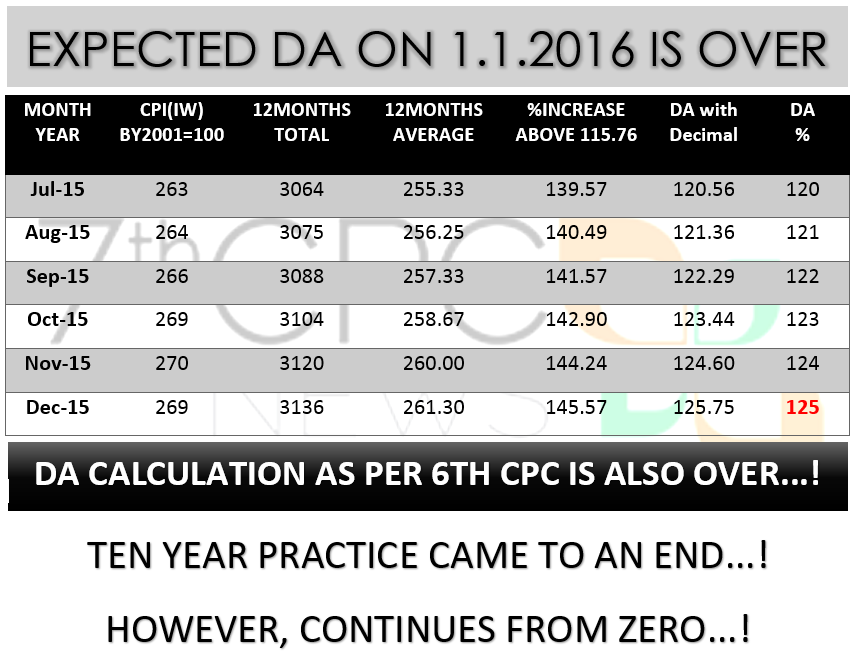
Expected DA on 1.1.2016 is Over – Ends with 6% Hike at 125%

The index is one point decreased and ends with 269. The AICPIN points for the months of July 2015 till December 2015, has concluded with some ups and downs. The AICPIN points that started at 263, has ended on an average of 261.4 points (263, 264, 266, 269, 270, and 269).
Since all the AICPIN points required for calculating the DA for the months of July to December have been released, the additional Dearness Allowance, which will be issued from the month of January 2016, has been decided. It will be implemented only after the central cabinet gives its approval.

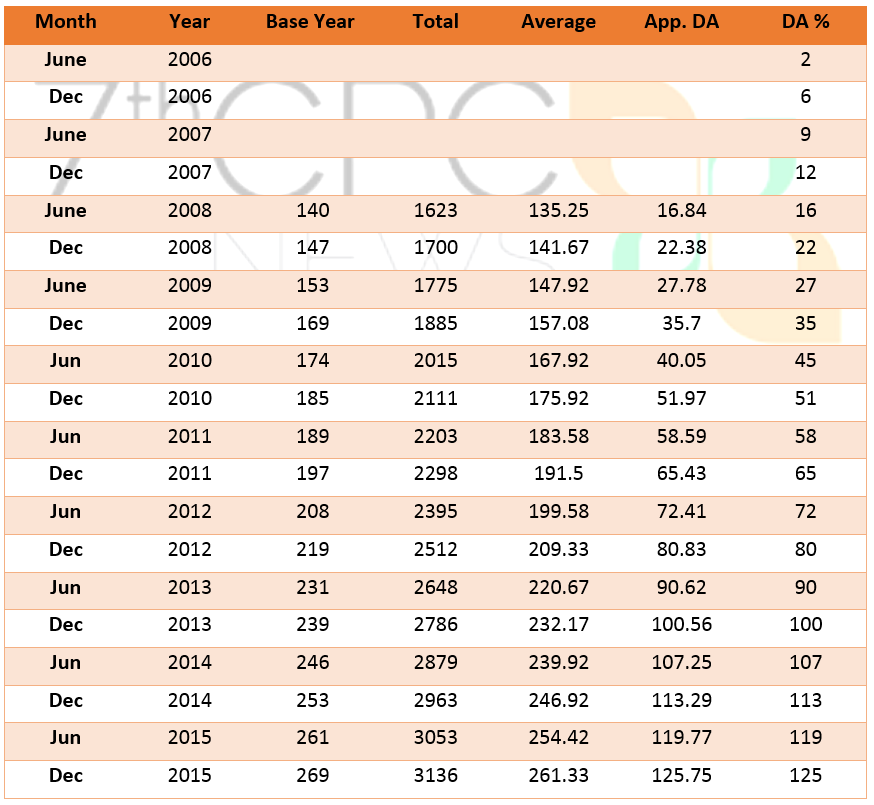
The final instalment of the DA, to be issued as per the recommendations of the 6th Pay Commission, will see an increase of 6 percent and end at 125%. With this, it concludes its 10-year-long journey.

EXPECTED-DA-FROM-JULY-2016-AS-PER-7TH-PAY-COMMISSION
Starting from January 2006, Dearness Allowance was revised 20 times based on the method recommended by the 6th Pay Commission. It began at zero on 01.01.2006, and increased, step by step, to 125 percent by 01.01.2016. In other words, there was an average increase of 6.25 % each time.
EXPECTED-DA-FROM-JULY-2016-AS-PER-7TH-PAY-COMMISSION-4
Since the final instalment of DA percent and the 2.57 Fitment Factor, recommended by the 7th Pay Commission, are closely related to each other, there is tremendous curiosity to know about it.

It is surprising that the 7th Pay Commission had very accurately predicted the rise.

Based on the recommendations of the 7th Pay Commission, the basic pay of all the Central Government employees will be calculated, with effect from 01.01.2016. There will be no dearness allowance for the six months starting from January to June 2016. The first instalment of the Dearness Allowance will be issued from July onwards.
The 7th Pay Commission has not recommended any changes in the DA calculation method. Therefore, the method implemented by the 6th Pay Commission will be used.
Based on the AICPIN points of January to June 2016, the additional DA will be calculated and will be given as the first instalment of the new DA.
It is being said that only after seeing the report submitted by the 13-member Empowered Committee constituted by the centre will the government decide on implementing the 7th Pay Commission reports.

Monday, February 1, 2016

7th Pay Commission Salary

Salary for Pay Band 5200-20200
Grade pay – 1800, 1900, 2000,2400, 2800

7th Pay Commission Salary for Pay Band 5200-20200

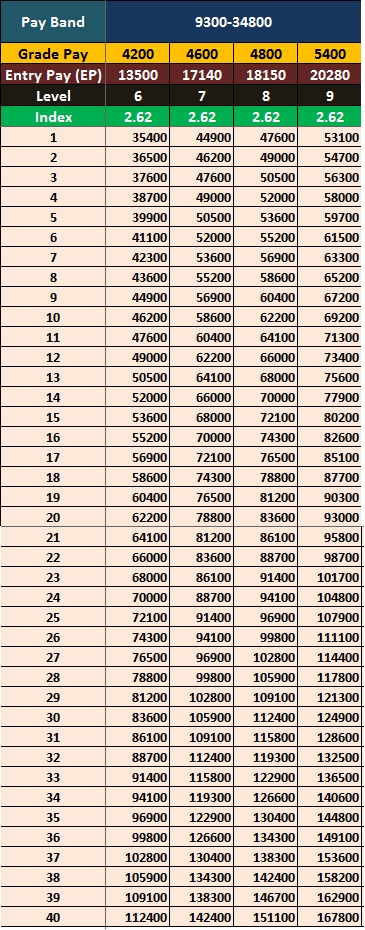
Salary for Pay Band 9300-34800
Grade pay – 4200,4600,4800,5400

7th Pay Commission Salary for Pay Band 9300-34800

7th Pay Commission Salary

7th Pay Commission Salary for Pay Band 15600-39100
Grade pay – 5400,6600,7600

7th Pay Commission Salary for Pay Band 15600-39100

Salary for Pay Band 37400-67000 
Grade pay – 8700,8900,10000

7th Pay Commission Salary for Pay Band 37400-67000

Salary for Pay Band 67000-79000

7th Pay Commission Salary for Pay Band 67000-79000

Implementation of the recommendations of the 7th CPC – Issues on way ahead.

F. No.1-1/2016- IC
Government of India
Ministry of Finance
Department of Expenditure
New Delhi, 29.1.2016
Meeting Notice
Subject: Meeting of Nodal officers of various Departments – implementation of the recommendations of the 7th CPC— Issues on way ahead.
In order to process the recommendations of the 7th Central Pay Commission, the Cabinet has approved setting up of an Empowered Committee of Secretaries chaired by the Cabinet Secretary. Accordingly, the ECOS has been set up as per this Ministry’OM No. 1-4/2015/EIII-A dt. 27.1.2016 (copy placed on the website of this Ministry, viz, www.finmin.nic.in).
2. As provided in the said OM dt. 271.2016, the Implementation Cell created in this Ministry shall work as the Secretariat for the ECOS.
3. This Ministry has already requested all the ministries/Departments vide DO letter No. 1-4/2015/EIII.A dt. 21.11.2015 from JS(Pers) addressed to all the Secretaries to nominate a nodal officer at the level of a Joint Secretary to interact with the Implementation Cell during the curse of processing of the recommendations of the 7th CPC.
4. Accordingly, Joint Secretary (Implementation Cell) shall take a meeting of all the Nodal Officers of the Ministries/Departments on 2.2.2016 at 11.00 a.m. in Conference Hall (R. No. 72), North Block, New Delhi to discuss the relevant issues in connection with the processing of the recommendations of the rh CPC and to concretise the points of action pertaining to all the Ministries/Departments in general and also in regard to specific issues concerning individual Ministries/Departments with a view to enabling an effective, holistic and quicker processing of the recommendations of the 7th CPC and for submission of the matter before the ECOS.
5. As this is the first meeting of the Nodal Officers to formulate the action points on the way ahead on processing of the recommendations of the rh CPC, it is requested that the concerned nodal officers may kindly make it convenient to attend the meeting
(Amar Nath Singh)
Deputy Secretary to the Government of India
To
All the nodal officers of Ministries/Departments, as per list attached.