Popular Posts

Tuesday, February 2, 2016

Expected DA on 1.1.2016 is Over – Ends with 6% Hike at 125%

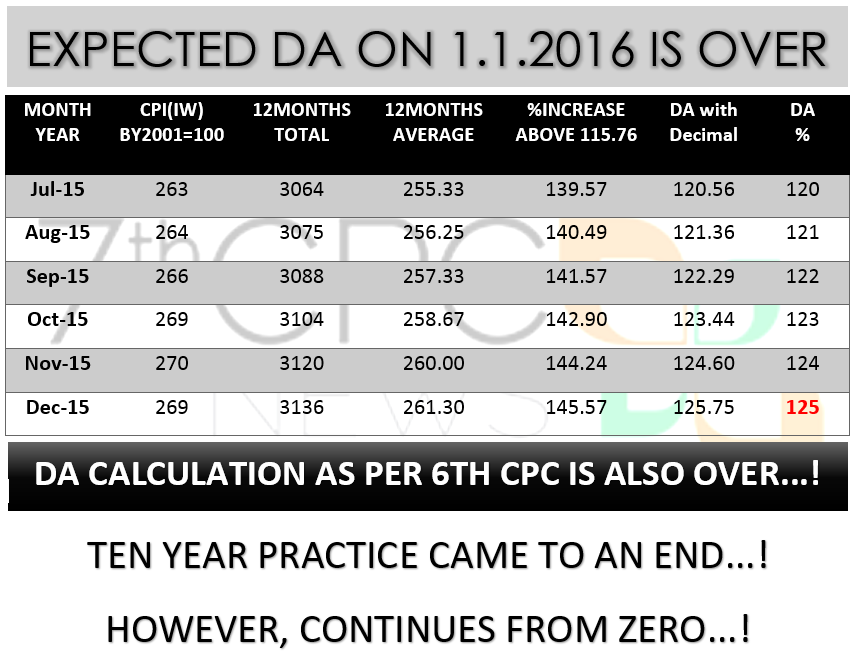
The index is one point decreased and ends with 269. The AICPIN points for the months of July 2015 till December 2015, has concluded with some ups and downs. The AICPIN points that started at 263, has ended on an average of 261.4 points (263, 264, 266, 269, 270, and 269).
Since all the AICPIN points required for calculating the DA for the months of July to December have been released, the additional Dearness Allowance, which will be issued from the month of January 2016, has been decided. It will be implemented only after the central cabinet gives its approval.

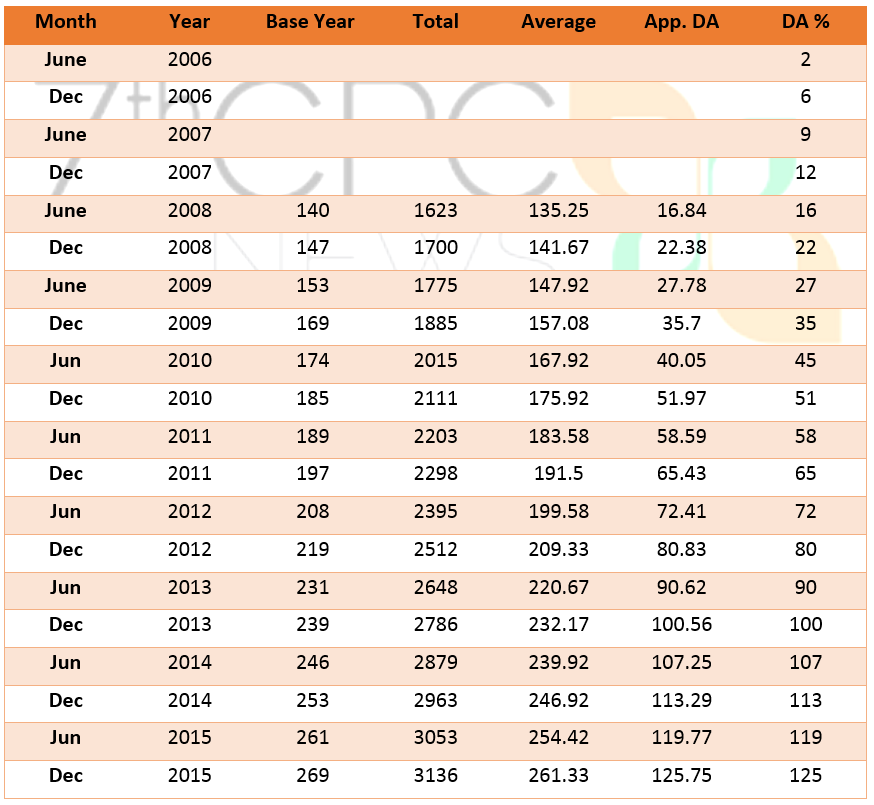
The final instalment of the DA, to be issued as per the recommendations of the 6th Pay Commission, will see an increase of 6 percent and end at 125%. With this, it concludes its 10-year-long journey.

EXPECTED-DA-FROM-JULY-2016-AS-PER-7TH-PAY-COMMISSION
Starting from January 2006, Dearness Allowance was revised 20 times based on the method recommended by the 6th Pay Commission. It began at zero on 01.01.2006, and increased, step by step, to 125 percent by 01.01.2016. In other words, there was an average increase of 6.25 % each time.
EXPECTED-DA-FROM-JULY-2016-AS-PER-7TH-PAY-COMMISSION-4
Since the final instalment of DA percent and the 2.57 Fitment Factor, recommended by the 7th Pay Commission, are closely related to each other, there is tremendous curiosity to know about it.

It is surprising that the 7th Pay Commission had very accurately predicted the rise.

Based on the recommendations of the 7th Pay Commission, the basic pay of all the Central Government employees will be calculated, with effect from 01.01.2016. There will be no dearness allowance for the six months starting from January to June 2016. The first instalment of the Dearness Allowance will be issued from July onwards.
The 7th Pay Commission has not recommended any changes in the DA calculation method. Therefore, the method implemented by the 6th Pay Commission will be used.
Based on the AICPIN points of January to June 2016, the additional DA will be calculated and will be given as the first instalment of the new DA.
It is being said that only after seeing the report submitted by the 13-member Empowered Committee constituted by the centre will the government decide on implementing the 7th Pay Commission reports.

Monday, February 1, 2016

7th Pay Commission Salary

Salary for Pay Band 5200-20200
Grade pay – 1800, 1900, 2000,2400, 2800

7th Pay Commission Salary for Pay Band 5200-20200

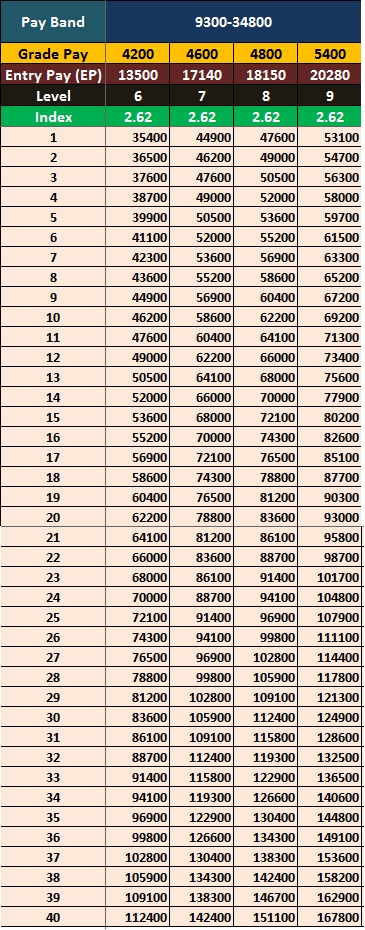
Salary for Pay Band 9300-34800
Grade pay – 4200,4600,4800,5400

7th Pay Commission Salary for Pay Band 9300-34800

7th Pay Commission Salary

7th Pay Commission Salary for Pay Band 15600-39100
Grade pay – 5400,6600,7600

7th Pay Commission Salary for Pay Band 15600-39100

Salary for Pay Band 37400-67000 
Grade pay – 8700,8900,10000

7th Pay Commission Salary for Pay Band 37400-67000

Salary for Pay Band 67000-79000

7th Pay Commission Salary for Pay Band 67000-79000

Implementation of the recommendations of the 7th CPC – Issues on way ahead.

F. No.1-1/2016- IC
Government of India
Ministry of Finance
Department of Expenditure
New Delhi, 29.1.2016
Meeting Notice
Subject: Meeting of Nodal officers of various Departments – implementation of the recommendations of the 7th CPC— Issues on way ahead.
In order to process the recommendations of the 7th Central Pay Commission, the Cabinet has approved setting up of an Empowered Committee of Secretaries chaired by the Cabinet Secretary. Accordingly, the ECOS has been set up as per this Ministry’s OM No. 1-4/2015/EIII-A dt. 27.1.2016 (copy placed on the website of this Ministry, viz, www.finmin.nic.in).
2. As provided in the said OM dt. 271.2016, the Implementation Cell created in this Ministry shall work as the Secretariat for the ECOS.
3. This Ministry has already requested all the ministries/Departments vide DO letter No. 1-4/2015/EIII.A dt. 21.11.2015 from JS(Pers) addressed to all the Secretaries to nominate a nodal officer at the level of a Joint Secretary to interact with the Implementation Cell during the curse of processing of the recommendations of the 7th CPC.
4. Accordingly, Joint Secretary (Implementation Cell) shall take a meeting of all the Nodal Officers of the Ministries/Departments on 2.2.2016 at 11.00 a.m. in Conference Hall (R. No. 72), North Block, New Delhi to discuss the relevant issues in connection with the processing of the recommendations of the rh CPC and to concretise the points of action pertaining to all the Ministries/Departments in general and also in regard to specific issues concerning individual Ministries/Departments with a view to enabling an effective, holistic and quicker processing of the recommendations of the 7th CPC and for submission of the matter before the ECOS.
5. As this is the first meeting of the Nodal Officers to formulate the action points on the way ahead on processing of the recommendations of the rh CPC, it is requested that the concerned nodal officers may kindly make it convenient to attend the meeting
(Amar Nath Singh)
Deputy Secretary to the Government of India
To
All the nodal officers of Ministries/Departments, as per list attached.

Thursday, January 28, 2016

Anomalies in Pension of Pre-2006 HAG / S-30 Grade Pensioners of Organised Group ‘A’ Services

1. 7th CPC has recommended pension formulation of past civilian employees retired prior to 01.01.2016, based on notional pay of the retiree which will be the minimum of the Level in the Pay Matrix corresponding to the Pay Band and Grade Pay at which he/she retired, duly raised by adding number of increments earned in that Level while in service, at the rate of three percent. The revised pension computed based on these parameters, i.e. minimum of the Level in Pay Matrix and number of increments earned in that Level will not be reasonable and will not impart due justice to pre-2006 HAG / S-30 grade pensioners of Organised Group ‘A’ Services. The pre-2006 pensioners of HAG / S-30 grade retired from Organised Group ‘A’ Services have been put to a great disadvantage compared to the pensioners of junior Levels and compared to post-2006 pensioners of the same Level who retired after getting non functional financial upgradation (NFFU) to the scale of HAG / S-30 grade in 2006 onwards, on implementation of 6th CPC recommendations. The issue needs to be examined in view of following submissions and remedial action taken so that the method of formulation of pension is not unreasonable and discriminatory to the above mentioned class of pensioners.

2. The revised pay scales for all Levels including Level 15 of 7th CPC Pay Matrix are based on implemented pay scale of 6th CPC. Anomaly in any of the implemented pay scales of 6th CPC therefore gets carried forward to the revised scale of that Level in 7th CPC Pay Matrix. Level 15 of the 7th CPC Pay Matrix corresponds to the scale of HAG and S-30 grades of 6th CPC and 5th CPC respectively. In connection with the anomalies in the implemented scale of HAG grade of 6th CPC, the following is relevant.

a. The pay scales of HAG / S-30 and HAG+ / S-31 have always been almost identical. The minimum of both the scales has always been same throughout right upto 5th CPC. The maximum of HAG+ / S-31 has, however, been slightly more than the maximum of HAG / S-30 scale. These scales from 3rd CPC to 5th CPC were as under:
HAG / S-30 HAG+ / S-31
3rd CPC 3000 Fixed 3000 – 3500
4th CPC 7300 – 7600 7300 – 8000
5th CPC 22400 – 24500 22400 – 26000

b. 6th CPC had recommended both these scales in the Pay Band PB 4 with Pay 39200 – 67000 and Grade Pay of 11000 for S-30 and 13000 for S-31. The difference in the recommended scales was 2000 only.

c. Both S-30 and S-31 scales were almost same in 6th CPC recommendations with slight difference of 2000, due to the following reasons:

i. S-30 and S-31 both grades were direct promotional grades from S-29, with the same experience of 3 years in S-29 grade.

ii. Promotion from both S-30 and S-31 to the next grade, i.e. S-32 was admissible directly. The experience required for promotion from either of these grades was same, which was 2 years.

iii. Wherever there was provision for promotion / upgradation from S-30 to S-31 scale, experience required in S-30 grade was nil.

d. During implementation stage of 6th CPC, S-30 and S-31 scales were taken out of PB 4 Pay Band and were placed in separate scales of 67000 – 79000 for S-30 and 75500 – 80000 for S-31 with no grade pay. At this stage, a substantial difference in starting pay of these scales, which was never there earlier, occurred. This had no justification keeping in view submissions at sub-paras (a) to (c) above and was unjust and discriminatory.

e. The pay scales of S-29 and S-30 grades from 4rd CPC to 6th CPC were as under:
SAG / S-29 HAG / S-30
4th CPC 5900 – 7300 7300 – 7600
5th CPC 18400 – 22400 22400 – 24500
6th CPC 37400 – 67000 plus 10000 Grade Pay 67000 – 79000

Upto 5th CPC, the officers of S-29 grade always got less/equal pay than S-30 grade. Consequently retirees from S-29 grade could never get higher pension than S-30 retirees. After implementation of 6th CPC w.e.f. 2006, the scale of S-29 extended upto 77000 (67000 pay in the band + 10000 grade pay) whereas the minimum of S-30 scale was 67000. After 2006, the retirees of S-29 scale, drawing pay above 67000 upto 77000, got pension above 33500 upto 38500, which was more than the admissible pension of 33500 of S-30 scale retirees at the rate of fifty percent of 67000, the minimum 6th CPC pay of the scale. The equation between the pension of S-29 and S-30 scale retirees thus got disturbed for the first time, when lower scale S-29 retirees got more pension than higher scale S-30 retirees, as the minimum pay of 6th CPC scale was less than the maximum of S-29 scale.

3. In view of submissions in para 2 above, the implemented 6th CPC pay scale for S-30 grade was anomalous with reference to both S-31 and S-29 scales. The justified and reasonable minimum pay of S-30 scale of 6th CPC should have been equal to the minimum of S-31 scale and not less than the maximum of S-29 scale which was 77000. Based on this justified minimum pre-revised pay of 77000, the revised pay scale of S-30 grade (Level 15 of Pay Matrix of 7th CPC) should have been 209500 (77000 x 2.72). Accordingly minimum revised pension for retirees of HAG / S-30 grade (Level 15 of Pay Matrix) at the rate of fifty percent of 209500 should be 104750.

4. After 2006, on implementation of 6th CPC scales, not only retirees from S-29 scale, even some of the retireesfrom S-26 and S-24 scales which were also in Pay Band PB4 and were two to three grades junior retired at pay exceeding 67000 and started drawing pension above 33500 which was more than the pension admissible to S-30 grade retirees. This being highly unreasonable, unjust and discriminative, the pre-2006 retirees from S-30 scale had to approach the courts for legal remedy. 

The issue came up for judicial scrutiny keeping in view the rules and legal position, reasonability, natural justice, constitutional provisions and various judgments of Apex Court on pension admissibility. CAT PB New Delhi in OA No. 937 / 2010 reviewed under RA No. 10 / 2015 between All India S-30 Pensioners Association and U.O.I. and High Court Patna in Civil Writ Case No. 10757 / 2010 between Shri MMP Sinha (a pre-2006 retiree from S-30 grade) and U.O.I., upheld that pre-2006 retirees of S-30 grade getting pension less than post-2006 retirees of lower grades is absolutely unreasonable, unjustified and against natural justice. 

The courts ordered that the pension of pre-2006 S-30 grade retirees should be stepped up to 38500 which the pensioners of lower grade were getting. As per courts’ verdict, based on pre-revised pension of 38500, therevised pension of S-30 retirees will be 98945 (38500 x 2.57). On implementation of 7th CPC scales in accordance with these judgments, the pension entitlement for S-30 grade (Level 15) pensioners has to be not less than what is admissible to post-2016 S-29 (level 14) retirees which is 109100 (fifty percent of 218200). Accordingly the justified revised pension of Level 15 / S-30 retirees should be 109100.

5. Before implementation of 6th CPC, promotions of the officers of Organised Group ‘A’ Service were much delayed as compared to those of IAS. 6th CPC commented that the huge time gap in promotion to various pay scales between Organised Group ‘A’ Services and IAS needed to be minimised and recommended that the officers of Organised Group ‘A’ Services should be given financial up gradation such that a particular batch of these services gets promotional scale of higher grade at various levels when any IAS officer of two year junior batch gets posted to the centre to those grades / levels. Based on these recommendations, from 2006 onward, 

Non Functional Financial Up gradation (NFFU) was given to the officers of Group ‘A’ Services on non functional basis and the upgraded officers continued to work in the lower grade posts from which they were upgraded though given the promotional scale of the higher post. With NFFU, after 2006, the officers’ pay got upgraded to the next promotional scale much earlier than prior to 2006, when higher scale was available only on regular promotion to higher grade / post.

6. The same method of pension formulation based on increments earned in retirement scale of Level 15 (HAG / S-30) of the Pay Matrix recommended for both, i.e. pre-2006 regular promotees to the grade and to post-2006 promotees who were upgraded to the same scale under NFFU after 2006, is therefore unjust for pre-2006 regular promotees who have been put to a great disadvantage. Pre-2006 promotees to HAG / S-30 grade (Level 15 of Pay Matrix) were promoted to HAG / S-30 grade against the vacant posts in higher grade and the entire period spent in the scale was much less, the maximum being around three years. 

The increment earned by them ranged from nil to two and as per 7th CPC formulation, their notional pay will range from 182200 to 193300 and revised pension will range from 91100 to 96650. As far as post-2006 promotees to HAG / S-30 grade are concerned, they were granted NFFU from SAG / S-29 grade on non functional basis to the higher Level scale tenable by HAG / S-30 grade officers irrespective of availability of posts in that grade in the year in which two years junior IAS officers batch got promotion to that grade. The period spent in the scale by them was around six years during which they were either functioning in the post of SAG / S-29 (Level 14) or could have got regular promotion / higher post for part of the period. 

These officers earned at least five increments in the higher Level unless they retired earlier and the period when they were working in lower posts is also being counted towards the increments earned in Level 15. As per 7th CPC formulation, their notional pay will be at least 211300 in recommended scale at Level 15 of Pay Matrix and pension will be 105650 minimum against the entitlement of 91100 to 96650 for pre-2006 promotees in that Level.

7. All the pensioners promoted before 2006 or upgraded after 2006 to the same Level, i.e. Level 15 form the same class of past pensioners having joined the same service through the same recruitment procedure and having retired at the same Level. Entitlement of different pensions to these two group of officers who are of the same class is unreasonable. The group of post-2006 promotees were not holding higher post for the entire period for which increments are being considered in the formulation of pension. 

The method of 7th CPC pension formulation is therefore discriminatory to pre-2006 promotees to the scale. In the past, the Apex Court has struck down any such unreasonable, unjust and discriminatory pension entitlement of the past pensioners. With a view to provide justice to pre-2006 pensioners of HAG grade (Level 15), their minimum notional pay needs to be stepped up by maximum number of increments drawn by post 2006 officers, upgraded under NFFU to HAG / S-30 scale from the year 2006 onward, for the period they functioned in the lower post of SAG / S-29 or upto one year of their regular promotion / placement in posts tenable by higher grade of HAG. The revised minimum pension should be according to this stepped up notional pay.

8. In view of foregoing, the reasonable and just minimum pension entitlement of the pensioners of Organised Group ‘A’ Services, who retired from Level 15 (HAG / S-30) works out to be as under on the basis as mentioned against each:

a. 104750. As per minimum pay of 209500 for Level 15 of Pay Matrix based on reasonable and just minimum pay of HAG / S-30 in 6th CPC scale (para 2 and 3 refer).

b. 98945 (38500 x 2.57). As per pension entitlement of the past pensioners retired before 2016 from lower level, i.e. Level 14 of Pay Matrix (SAG / S-29 grade), based on pension of 38500 being drawn by them prior to 2016 (para 4 refers).

c. 109100. As per pension entitlement of the pensioners of lower level, i.e. Level 14 of Pay Matrix (SAG / S-29 grade) retiring in 7th CPC regime, i.e. 2016 onwards (para 4 refers).
Constitution of Empowered Committee of Secretaries for processing the Report of the Seventh Central Pay Commission-finmin orders

No.1-4/2015-E.III(A)
Government of India
Ministry of Finance
Department of Expenditure
New Delhi, dated the 27th January, 2016
OFFICE MEMORANDUM
Subject: Constitution of Empowered Committee of Secretaries for processing the Report of the Seventh Central Pay Commission
It has been decided with the approval of the Cabinet to set up an Empowered Committee of Secretaries to process the recommendations of the Seventh Central Pay Commission The Committee will have the following members
1.Cabinet Secretary–              Chairman
2.Finance Secretary/Secretary (Expenditure)–              Member
3.Secretary, Department of Personnel & Training                Member
4.Secretary, Department of Pension & PW–              Member
5.Secretary, Ministry of Home Affairs–              Member
6.Secretary, Ministry of Defence–              Member
7.Secretary, Department of Revenue–              Member
8.Secretary, Department of Posts–              Member
9.Secretary, Department of Health–              Member
10.Secretary, Department of Science & Technology–              Member
11.Chairman, Railway Board–              Member
12.Deputy Comptroller & Auditor General–              Member
13.Secretary (Security), Cabinet Secretariat–              Member
2. The Committee may co-opt any other Secretary, whenever found necessary.
3. The Empowered Committee will function as a Screening Committee to screen the recommendations of the Commission after taking into account the views of the concerned stakeholders, viz, the Ministries/Departments, Staff Associations and the JCM, so as to firm up the final conclusions for approval of the Cabinet.
4. The Implementation Cell created in the Department of Expenditure shall function as Secretariat for the Empowered Committee of Secretaries.
5. The final recommendations of the Empowered Committee of Secretaries will be submitted for approval of the Cabinet.
Sd/-
(Annie George Mathew)
Joint Secretary to the Government of India

Wednesday, January 27, 2016

Change of Definition of OROP

   25th January 2016
Shri Manohar Parrikar                                                                                   Hon’ble Raksha Mantri                                                                                   104, South Block, New Delhi

Change of Definition of OROP
in Various Correspondence of DESW Noticed

Dear Sh Manohar Parrikar Ji
Pl refer to:
1.   MOD letter no 12(01/2014-D (Pen/Pol) dated 26 Feb 14
2.   MOM of the meeting chaired by RM on 26 Feb 14 to discuss OROP
3.   Reply of MOS Defense Sh Rao Inderjit Singh Dated 2 Dec 14 in a written reply to Sh Rajeev Chandrashekhar in Rajya Sabha
4.   GOI press release dated 5 Sep 15
5.   GOI letter no 12(1)/2014 dated 7 Nov 15 and
6.   GOI letter no 12(01)/2014-D(pen/pol)- Part–II dated 14 Dec 15
GOI has accepted following definition of OROP in the letters dated 26 Feb 14 and MOS statement in Rajya Sabha dated 2 Dec 14.

One Rank One Pension (OROP) implies that uniform pension be paid to the Armed Forces Personnel retiring in the same rank with the same length of service irrespective of their date of retirement and any future enhancement in the rates of pension to be automatically passed on to the past pensioners. This implies bridging the gap between the rate of pension of the current pensioners and the past pensioners, and also future enhancements in the rate of pension to be automatically passed on to the past pensioners.

However in the Press Release dated 5 Sep 14, a phrase has been added at the end of the OROP definition “at periodic intervals”.

Definition of OROP given in 5 Sep Press Release is given below:

One Rank One Pension (OROP) implies that uniform pension be paid to the Armed Forces Personnel retiring in the same rank with the same length of service, irrespective of their date of retirement.Future enhancement in the rates of pension to be automatically passed on to the past pensioners. This implies bridging the gap between the rate of pension of the current pensioners and the past pensioners at periodic intervals.

This phrase has probably been added to justify pension equalisation every five years as is being propagated by the MOD.

Again, another attempt has been made to change/ distort the definition of OROP in GOI notification dated 7 Nov 15. OROP definition given in 7 Nov letter is reproduced below.

One Rank One Pension (OROP) implies that uniform pension be paid to the Defence Forces Personnel retiring in the same rank with thesame length of service, regardless of their date of retirement, which implies bridging the gap between the rate of pension of the current pensioners and the past pensioners at periodic intervals.

I am sure you would notice subtle progressive change in the language of definition of OROP, wherein the line “This implies bridging the gap between the rate of pension of the current pensioners and the past pensioners, and also future enhancements in the rate of pension to be automatically passed on to the past pensioner” has been changed with the line “This implies bridging the gap between the rate of pension of the current pensioners and the past pensioners at periodic intervals”.

It further states as one of the salient features that it has been decided that the gap between rate of pension of current pensioners and past pensioners would be refixed every five years.

This completely changes the definition of OROP and if implemented in its changed form, it will deprive past pensioners of monetary benefits and will completely destroy the definition of OROP and in turn, destroy the very soul of OROP.

UFESM (JM) believes that this change in the definition in OROP has been inserted only to justify pension equalisation every five years. Pension equalisation every five years is against the definition of OROP and is a matter of serious concern for all Ex-servicemen. The correct and acceptable situation is that pension equalisation must be done as soon as pension of two soldiers with same rank and same length of service is noticed to be different and it must be equalised immediately. Ex-servicemen are ready to accept pension equalisation every year only to make administration of this concept easily implementable. Incidentally, any computation can be easily achieved on press of a button in today’s computer era – and this needs no emphasis.

However the matter did not end at one instance of change of definition of OROP, it has been once again repeated in GOI letter dated 14 Dec 15 “OROP implies that uniform pension be paid to the Defence Forces Personnel retiring in the same rank with the same length of service, regardless of their date of retirement, which implies that bridging the gap between the rate of pension of current and past pensioners at periodic intervals”.

The GOI letter dated 14 Dec 15 is the notification for the formation of one-man judicial committee. It is a matter of great importance that if incorrect definition is given to the Chairman of anomalies committee, he is bound to work within the constraints given by MOD and will thus give his recommendations as per incorrect definition given to him. This will be gross injustice to ex-servicemen. Ex-servicemen might be justified to think that these changes are a planned move for the vexed problem of OROP in view of the past experiences in which meanings of Honorable Supreme Court orders were changed by making subtle changes in the decision of HSC.

We sincerely hope that these changes are probably only clerical errors and not a planned direction change. We therefore sincerely request you to correct these mistakes in definition of OROP and give following definition approved by Parliament to all committees.

One Rank One Pension (OROP) implies that uniform pension be paid to the Armed Forces Personnel retiring in the same rank with thesame length of service irrespective of their date of retirement and any future enhancement in the rates of pension to be automatically passed on to the past pensioners. This implies bridging the gap between the rate of pension of the current pensioners and the past pensioners, and also future enhancements in the rate of pension to be automatically passed on to the past pensioners.


We will be thankful to get a suitable reply from you at the earliest.

With regards,

Yours Sincerely,

Maj Gen Satbir Singh, SM (Retd)                                                      Advisor United Front of Ex Servicemen & Chairman IESM              Mobile: 9312404269, 01244110570                                          Email:satbirsm@gmail.com